The Yamaha R15 has built a rather unusual reputation for a small-capacity motorcycle. It may have a relatively modest engine, but it has never really looked or felt like an ordinary commuter bike.
That is exactly why talk of a possible Yamaha R15 V5 continues to attract so much attention. The current R15 V4 has been around for several years, and naturally, riders are beginning to wonder what Yamaha could do with the next generation.
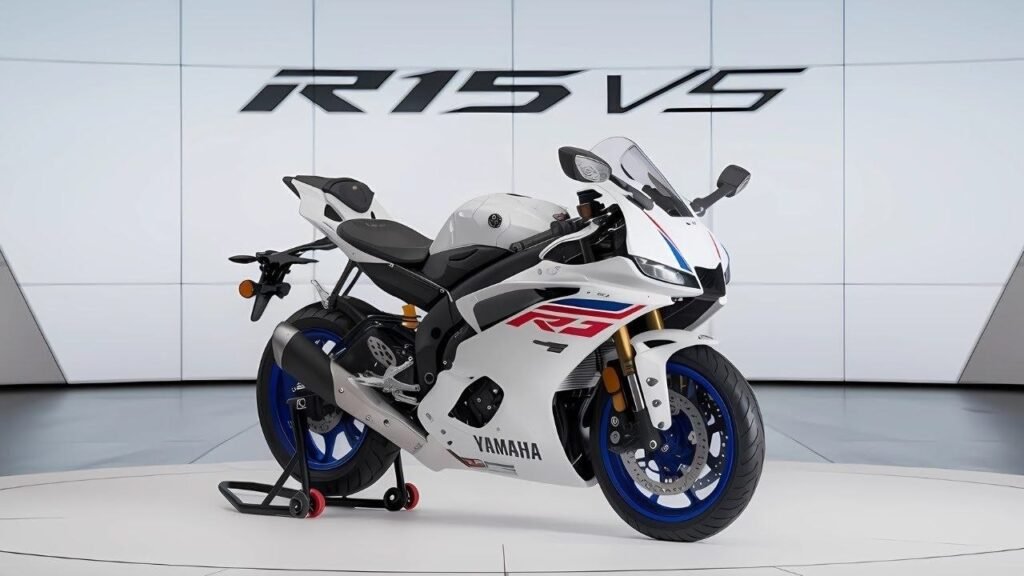
There is just one important detail to keep in mind before getting too excited: Yamaha has not officially confirmed an R15 V5 at the time of writing. There is no official UK specification, confirmed UK price or launch date for an R15 V5 yet. Much of what is being discussed online is based on expectations, rumours and speculation rather than information released by Yamaha.
So, rather than presenting rumours as facts, here is what we can realistically expect from a future R15 V5 and where the bike would fit in the UK market.
Why the R15 V5 is attracting attention
The R15 has always been different from most 150cc-class motorcycles.
From the beginning, Yamaha gave the R15 a proper sports-bike identity. The riding position, full fairing, lightweight chassis and R-series styling made it feel much closer to a miniature supersport than a conventional small bike.
The R15 V4 pushed that idea even further with features such as Variable Valve Actuation, a Deltabox-style chassis, upside-down front forks on higher versions and modern rider aids.
That creates a difficult job for Yamaha.
A V5 cannot simply be a slightly different headlight and a new set of graphics. Riders will expect the next-generation bike to offer something genuinely worthwhile.
At the same time, Yamaha would not want to change the formula so much that it loses the qualities that made the R15 popular in the first place.
Yamaha R15 V5 design: what could change?
If Yamaha eventually introduces an R15 V5, styling is likely to be one of the biggest areas of change.
The existing R15 already takes strong inspiration from Yamaha’s larger R-series motorcycles, so the next version could push that connection further.
A sharper front fairing, slimmer LED lighting and revised aerodynamic surfaces would make sense. Yamaha has been giving its newer R-series models increasingly focused designs, and the R15 is exactly the sort of motorcycle where that visual language works.
There could also be changes around the side fairings and fuel tank.
The current R15 has a fairly compact appearance, but a redesigned body could make the motorcycle look wider and more substantial without adding much actual weight.
The tail section could receive attention as well. A slimmer rear end and revised LED tail lamp would help the bike look more modern from behind.
That said, it is worth being careful with some of the images circulating online. Several R15 V5 pictures and renders shared on social media are unofficial, so they should not be treated as photographs of the production motorcycle.
Will the R15 V5 use a 155cc engine?
This is probably the question most potential buyers will ask.
The existing R15 platform uses Yamaha’s 155cc liquid-cooled single-cylinder engine with Variable Valve Actuation. The VVA system is one of the reasons the current motorcycle manages to combine everyday usability with a willingness to rev.
If Yamaha develops an R15 V5, retaining a version of this engine would be a logical move.
There is no official V5 engine specification yet, however, so claims about exact horsepower or torque should be treated as estimates rather than confirmed figures.
The current R15’s engine already has a strong reputation for being refined and relatively efficient. Yamaha therefore has little reason to throw the whole concept away.
A future version could instead receive improvements to throttle response, refinement, emissions and fuel efficiency.
For a motorcycle of this size, those changes can be more meaningful in everyday riding than a small increase in peak power.
Performance could remain focused on balance
One thing that has always made the R15 interesting is that it is not simply about producing the biggest possible power figure.
A lightweight sports bike does not need enormous horsepower to feel entertaining.
The combination of a rev-happy engine, compact dimensions, relatively low weight and a sporty chassis gives the R15 its character.
That philosophy is likely to remain important if the V5 arrives.
Yamaha could make the engine slightly stronger, but a major jump in performance would also increase costs, emissions and potentially insurance expenses.
For a bike aimed at riders stepping into the sports-bike world, predictable performance and good handling arguably matter more.
This is where the R15 has traditionally been strongest.
Six-speed gearbox and VVA technology
A six-speed gearbox would be expected on a future R15 V5, especially given the motorcycle’s sporty character.
The existing R15 benefits from having closely spaced ratios that allow riders to keep the engine within its useful rev range.
The VVA system also helps make the single-cylinder engine more flexible.
At lower engine speeds, the bike remains manageable for normal road riding. As the revs rise, the system changes valve operation to help the engine continue producing useful power higher in the rev range.
It is one of those technologies that sounds complicated on paper but makes more sense once you ride the bike.
A future V5 could refine this system rather than replacing it entirely.
Could quickshifter and traction control become standard?
This is another area where expectations are high.
The R15 already offers sophisticated equipment on higher variants, including a quickshifter and traction-control technology on the R15M in the Indian market.
If Yamaha introduces a V5, it would make sense for some of these features to become more widely available.
A quickshifter would suit the bike particularly well because of its sporty six-speed transmission. It allows faster upshifts without using the clutch in the conventional way.
Traction control is also useful on a lightweight sports bike, particularly when road conditions are wet.
However, whether Yamaha makes these features standard across every version is impossible to say until the company provides official details.
Chassis and handling
This is arguably more important than a headline horsepower number.
The R15’s appeal has always been closely linked to the way it handles. Its compact chassis gives the bike an agile feel, while the sporty riding position encourages riders to take advantage of corners rather than simply riding in a straight line.
A future V5 could receive revisions to the frame, suspension settings and steering geometry.
The goal would not necessarily be to make the bike dramatically more aggressive.
Instead, Yamaha could focus on making it easier to ride quickly while also improving stability at higher speeds.
For everyday UK roads, that balance would be particularly useful.
British roads are not exactly famous for having perfectly smooth surfaces, so suspension setup matters. A motorcycle that feels fantastic on a smooth track but becomes uncomfortable over potholes and broken tarmac would not make much sense as a daily road bike.
Braking and ABS
The R15 V5 would almost certainly continue with disc brakes and ABS, although the exact hardware remains unconfirmed.
The current R15 already uses a sporty braking setup, and a future model could receive revised calipers or discs depending on Yamaha’s engineering decisions.
For a small sports bike, braking feel is just as important as outright stopping power.
A good system should give the rider confidence without making the bike difficult to control.
ABS is particularly useful on public roads because road conditions can change quickly. Wet surfaces, diesel spills and unexpected obstacles are very different from the controlled environment of a racetrack.
What could the dashboard look like?
This is another area where the next-generation R15 could see a substantial upgrade.
Modern Yamaha motorcycles increasingly use colour displays and smartphone connectivity, so a future R15 V5 could follow the same direction.
A full-colour TFT display would certainly make the bike feel more premium.
Bluetooth connectivity could also allow riders to connect their phones for calls, music or navigation-related information.
But there is a balance to find.
A sports bike should not become so dependent on its touchscreen that basic functions become difficult to use while riding.
Good physical controls and a clear display are still more useful than simply having the largest possible screen.
Could the R15 V5 be lighter?
Possibly, although this is another area where we should avoid treating speculation as confirmed information.
Reducing weight is one of the easiest ways to improve the character of a small motorcycle.
A lighter R15 would potentially accelerate more quickly, change direction more easily and feel less intimidating to newer riders.
The problem is that reducing weight without sacrificing strength or equipment can become expensive.
If Yamaha adds more electronics, a larger display and additional safety technology, some of the weight saved elsewhere could simply be used up again.
The final result would therefore depend on Yamaha’s engineering priorities.
Expected Yamaha R15 V5 price in the UK
This is probably the area where online speculation needs the biggest warning label.
There is currently no official UK price for the Yamaha R15 V5, because Yamaha has not officially announced the model.
It would also be misleading to simply convert the Indian R15’s price into pounds and call that a UK price. UK pricing includes different taxes, distribution costs, homologation requirements and market positioning.
There is another important point here: Yamaha’s official UK and European range currently includes the R125, not the R15. The 2026 R125 is Yamaha’s lightweight supersport for the European market and produces 15 PS from its 125cc engine.
That means a future R15 V5 would need to be considered separately from the R125 if Yamaha ever decided to offer it in the UK.
For now, any exact R15 V5 UK price circulating online should be treated as an estimate.
What about the UK launch date?
There is no confirmed UK launch date either.
This is important because many websites publish specific dates for upcoming motorcycles even when the manufacturer has said nothing officially.
Until Yamaha announces the motorcycle, there is simply no reliable date to quote.
The situation is slightly different in markets where the R15 name is already established. But that does not automatically mean a future version would be sold in Britain.
Yamaha’s European product strategy is not identical to its Indian-market strategy, and the R125 already occupies the small-capacity supersport position in the official UK range.
Yamaha R125 vs a possible R15 V5
For UK riders, this comparison would probably be more useful than comparing the R15 V5 with larger 300cc motorcycles.
The current 2026 Yamaha R125 has a 125cc liquid-cooled single-cylinder engine, 15 PS, 11.5 Nm of torque and a six-speed gearbox. Yamaha quotes fuel consumption of 2.1 litres per 100km, equivalent to roughly 134mpg UK under the stated test figure.
It is also fully aligned with the European 125cc category, making it suitable for the licensing structure that exists in the UK.
The R15, with its larger 155cc engine, belongs to a different category.
So even if Yamaha eventually introduces a V5, its position in Britain would depend heavily on how the company decides to homologate and market it.
For now, the R125 remains the official Yamaha R-series choice for UK riders looking for a lightweight supersport.
Is it worth waiting for the R15 V5?
If you are specifically interested in buying a small Yamaha sports bike, there is no point putting off a purchase indefinitely based on rumours.
The current R125 is a real motorcycle that can be bought in the UK, and the 2026 version already receives updated graphics and colour options while retaining its 125cc supersport formula.
The R15 V5, on the other hand, remains unconfirmed.
If Yamaha eventually announces it, then there will be plenty of time to compare the specifications, price and equipment with the R125 and other lightweight sports bikes.
Until then, it is better to separate what Yamaha has actually announced from what enthusiasts hope will happen.
Final verdict
The idea of a Yamaha R15 V5 is certainly exciting.
The R15 has already shown that a small-capacity motorcycle can offer much more than basic transportation. Its sporty design, high-revving engine, compact chassis and strong connection with Yamaha’s larger R-series machines have helped it build a loyal following.
A V5 could take that formula further with sharper styling, updated electronics, improved refinement and possibly more sophisticated rider technology.
But for now, those are expectations rather than confirmed specifications.
Yamaha has not officially announced an R15 V5 or published a UK price and launch date.
For British riders, the situation is even clearer: Yamaha’s current 2026 lightweight supersport offering is the R125, with a 125cc engine and 15 PS.
So, if you see claims online about an exact R15 V5 price, confirmed launch date or final specification, take them with a little caution.
The next-generation R15 may eventually arrive, but until Yamaha itself pulls the covers off the bike, the most sensible approach is to treat the V5 as an anticipated model rather than an officially confirmed motorcycle.